Project description
Third-cycle subject: Computer Science
We are looking for a highly-qualified and motivated individual to pursue a PhD in the area of reliable conversational domain-specific data exploration and analysis. The prospect PhD student will join a research team in KTH led by Professor Aristides Gionis. The position is part of the European project ARMADA funded by the Marie-Skłodowska-Curie Doctoral Network.
The ARMADA project operates within the fast-growing field of Conversational AI, aiming to address critical issues related to the reliability and quality of large language models (LLMs) such as ChatGPT and Gemini. These models are increasingly used in essential sectors like healthcare, education, and law, where inaccurate or misleading responses –- known as “hallucinations” –- can have serious consequences. ARMADA seeks to develop solutions that make these AI systems more trustworthy, coherent, and verifiable by involving users directly in the response validation process and ensuring that every answer is traceable to a clear source and justification.
The project will focus on interdisciplinary approaches that combine artificial intelligence, machine learning, natural language processing, and social sciences. This collaborative and cross-sectoral approach aims to produce robust methods for evaluating AI outputs while also promoting inclusivity and ethical design.
Supervision: Professor Aristides Gionis
What we offer
- The possibility to study in a dynamic and international research environment in collaboration with industries and prominent universities from all over the world.
- A workplace with many employee benefits and monthly salary according to KTH’s Doctoral student salary agreement.
- In addition to the starting basic salary mentioned in above link, all positions within Marie Curie contains a mobility allowance and possible family allowance. For more info Basic salary and supplementary allowances are specified pre tax.
- A postgraduate education at an institution that is active and supportive in matters pertaining to working conditions, gender equality and diversity as well as study environment.
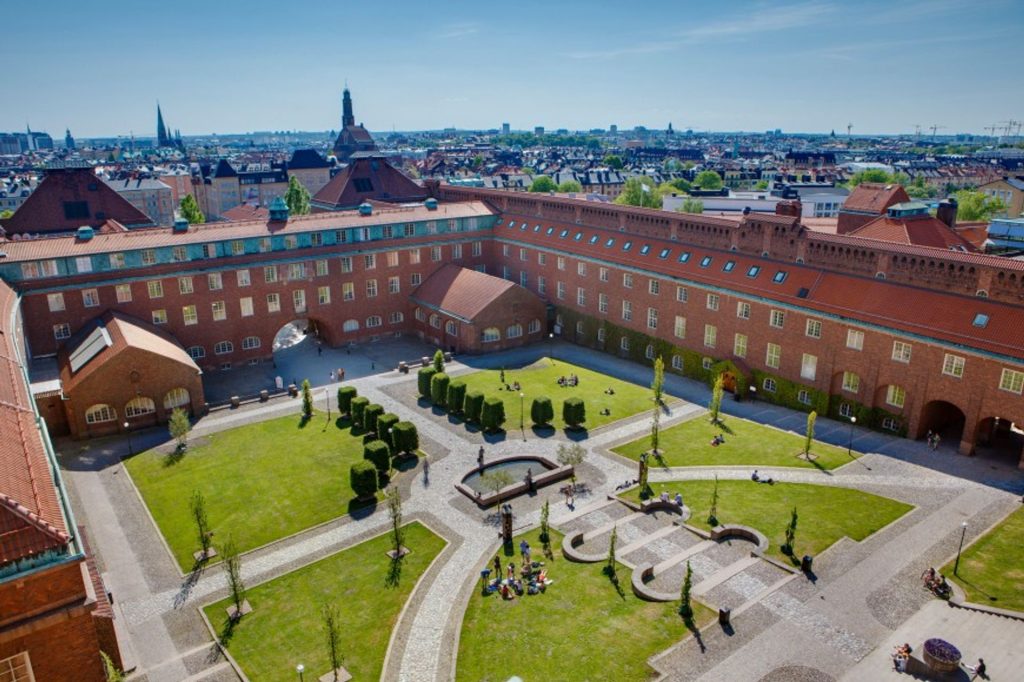
- Work and study in Stockholm, close to nature and the water.
- Guidance on relocating and settling in at KTH and in Sweden
Admission requirements
To be admitted to postgraduate education (Chapter 7, 39 § Swedish Higher Education Ordinance), the applicant must have basic eligibility in accordance with either of the following:
- passed a second cycle degree (for example a master’s degree), or
- completed course requirements of at least 240 higher education credits, of which at least 60 second-cycle higher education credits, or
- acquired, in some other way within or outside the country, substantially equivalent knowledge.
- Candidates cannot hold a doctoral degree.
Mobility: the candidate must not have resided or carried out their main activity (work, studies, etc.) in Sweden for more than 12 months in the 36 months immediately before their recruitment date.
In addition to the above, there is also a mandatory requirement for English equivalent to English B/6.
Selection
In order to succeed as a doctoral student at KTH you need to be goal oriented and persevering in your work. During the selection process, candidates will be assessed upon their ability to:
- independently pursue his or her work
- collaborate with others,
- have a professional approach,
- analyze and work with complex issues,
- be proficient in communicating in English, spoken and written,
- demonstrate strong implementation skills, and
- experience with managing large-scale data.
The successful candidate holds/or are about to receive a Master of Science degree in computer science, data science, or a related area, and have strong background in algorithmic design, data mining, machine learning, and combinatorial optimization.
Doctoral students are expected to be able to publish high-quality papers and develop research prototypes.
After the qualification requirements, great emphasis will be placed on personal skills.
Target degree: Doctoral degree
https://www.kth.se/lediga-jobb/839146?l=en
About the Author